Just hen you Think that your growth Is Over, you may be in for a surprise.
Most people assume that once puberty ends, so does their chance of getting taller and they are right. But it’s not always the case.
Because the human body doesn’t always follow the rulebook. And it’s not cast in stone that growth has to end at a certain age.

In some cases, though rare, the body has a remarkable ability to catch up or to grow faster than normal after a period of slowed or delayed growth. This phenomenon is known as catch-up growth.
What Exactly Is Catch-Up Growth?
Growth retardation may occur as a result of an injury such as starvation, hormonal deficiency, or poor nutrition.
Catch-up growth is your body’s natural way of making up for lost time.
Catch-up growth refers to a phase where an individual grows faster than what’s normally expected for their age, usually lasting a year or more, after their growth had previously slowed down or been temporarily held back.
This rapid growth can be measured by height velocity.
Because it involves a sudden boost in growth, catch-up growth can sometimes look similar to the growth spurt that happens during puberty, which makes it tricky to differentiate the two .
Babies who were small at birth due to conditions like intrauterine growth restriction often show this kind of accelerated growth later on, even though they may not fit every technical requirement of true catch-up growth.
There’s no perfect way to know in real time if a person has fully completed their catch-up growth. However, if they eventually reach a final height that falls within their expected genetic height range, it’s a strong sign that their catch-up process was successful [1]
Catch up growth normally happens after a growth delay that is caused by either illness, poor nutrition, stress, or hormonal imbalance.
Once the obstacle to growth is removed, the body accelerates growth to return to its original genetic path.
Think of it like pressing the accelerator after being stuck in traffic — your body speeds up to reach where it was meant to be.
Scientists first noticed catch up growth in children recovering from severe malnutrition.
Once these children began receiving proper nutrition, they often grew faster than normal for months or even years, until they reached their genetically predetermined height.
What’s the Science behind Catch up Growth?
The mechanisms regulating catch-up growth are not fully understood but there are 2 main hypotheses that
have been proposed to explain catch-up growth:
1.The neuroendocrine hypothesis.
This hypothesis, which was proposed by James M. Tanner a prominent British pediatric endocrinologist and a foundational researcher in the concept of “catch-up growth in 1963, suggests that a mechanism—possibly located in the hypothalamus—is able to compare the size of the individual’s body with the expected
size for that age.
If a mismatch is recognized, the body is encouraged to continue growing at a faster-than-normal rate.
When the mismatch becomes less obvious, then the growth velocity will decrease.
2. The growth plate hypothesis.
The growth plate hypothesis which is based on an old concept proposed by Osborne and Mendel in 1914, showed that prolonged nutritional deprivation in the rat was followed by growth at an age well beyond the normal growth period of the species.
According to this hypothesis, age is not the limiting factor for growth, rather growth is limited by the intrinsic capacity
for growth of the tissue itself.After further work in this area by Williams, a study in rabbits suggested that the mechanism for catch-up growth is intrinsic to the growth plate.
They proposed that catch-up growth arises from a delay in normal growth plate closure.
Thus, according to the study, growth plate closure is not a function of time per se but rather
a function of the cumulative number of divisions the stem cells
have undergone.
The different forms of Catch-Up Growth.
James Tanner distinguished 3 different types of catch growth that potentially lead to the same normal
adult height. But type 3 can’t formerly be considered catch up growth so only type 1 and 2 will be discussed.
- Catch-Up Growth type 1
In the first pattern, elimination of the growth restriction factor or factors is followed by an increase in height velocity
up to 4 times the average velocity of growth for individuals of a given age, which fully eliminates the growth deficit.
Once the original growth curve is achieved, height velocity returns to normal.
This is considered the classic example of catch-up growth and has been reported for several children.
This form of catch up growth can be observed in children suffering from celiac disease who experience a growth restriction.
Catch-Up Growth pattern 2
In the second type, once the growth restriction factor is removed, growth velocity increases only by a small amount.
The height deficit is compensated for over a long period of time.
An example of this type of catch-up growth was given in a report on 2 men with hypopituitarism. When GH treatment was started,
these men were aged 22.7 and 24.3 years and their bone age was 13 to 14 years.
Hypopituitarism: Is a condition where the pituitary gland fails to produce enough hormones in this case, GH.By ages 27.9 and 29.1 years, respectively, they had gained 8 and 9 inches in height, and their growth velocity was normal
for their bone age. [2]
Read more about bone age and how it determines adult growth potential on What Is Bone Age? How It Affects Growth and Puberty article.
MAJOR CAUSES OF GROWTH RETARDATION THAT MAY LEAD TO CATCH UP GROWTH.
1.Growth Hormone Deficiency.
A rare condition where the pituitary gland fails to release enough growth hormone.
In children, it affects approximately 1 in 3,500 to 10,000 children worldwide and it is more common in males than in females.
In most cases, the cause of growth hormone deficiency in children can’t be identified but in other cases, G.h deficiency is caused by a damage to the pituitary gland which may be present at birth or develop later during childhood.
How to naturally increase growth hormone release during and after puberty
Some of the signs that a child may be affected with G.h deficiency include a child being shorter that other children of same age and sex and looking young for their age.
Diagnosis is mainly done through blood tests.
Treatment of G.h deficiency is by daily or weekly injection of synthetic man made G.h under the skin by qualified medical personnel and the dosage depends on the child’s weight and growth rate.
synthetic G.h treatment can induce catch-up growth in children with g.h deficiency, but how they respond to the treatment is a function of starting age, how short they are compared to their peers, frequency of g.h admnistration and consistency of admnistaration.[3 ]
Starting GH therapy as early as soon as a deficiency is diagnosed is highly recommended for the best results preferably at around 2 to 4 years or before the onset of puberty.
2 .Hypothyroidism.
A condition where the thyroid gland doesn’t secrete enough thyroid hormones for your boy’s needs.
The main thyroid hormones are Triiodothyronine which regulates metabolism and Calcitonin which helps to regulate blood calcium levels by channeling it to bone tissue.
Some of the signs that a child may be suffering from hypothyroidism include weight gain, constipation, always feeling tired, difficulty concentrating as well as a h
constant tiredness, weight gain, constipation, and cold intolerance. Other indicators can be dry skin and hair, difficulty concentrating, as well as a a raspy, breathy, or weak-sounding voice.
The growth retardation observed in hypothyroidism appears
to be a direct effect of Triiodothyronine hormone deficiency on skeletal growth, but a secondary reduction of GH secretion and circulating
insulin-like growth factor-1 may also play a role.
Once Triiodothyronine hormone replacement therapy is commenced, a period of catch-up growth starts in most young children.
3 .Celiac disease
In affluent countries, celiac disease is one of the most prevalent causes of reversible growth retardation.
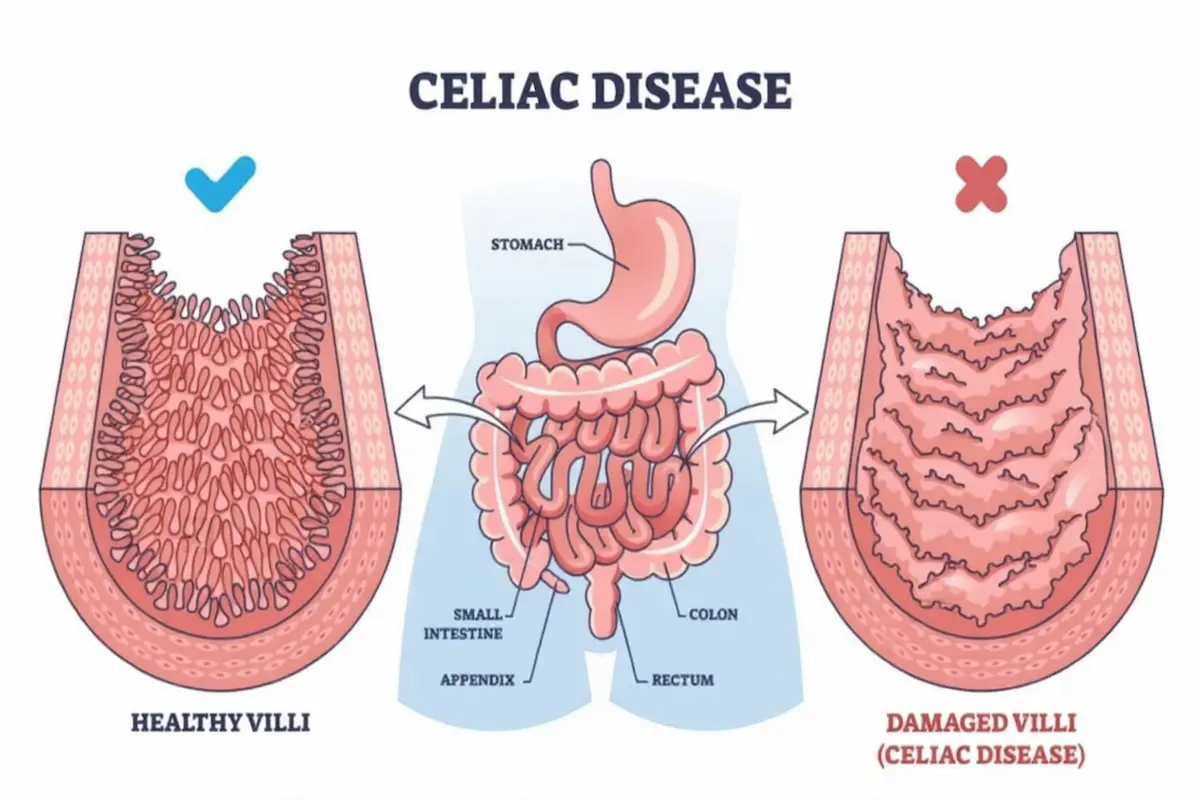
Celiac disease is a condition or disease where eating foods made from wheat, barley and rye like bread triggers an autoimmune mediated response which causes damage to the small intestines and leads to mal absorption of such food.
Such foods contain dietary gluten, which is a protein found in wheat, barley, and rye.
Some of the common symptoms of celiac disease include diarrhea, constipation, bloating and abdominal discomfort.
Elimination of such foods from the patient’s diet is considered an effective treatment for celiac disease and the symptoms usually disappear
quite rapidly and most patients exhibit complete catch-up growth within the first 6-12 months after initiation.
of the gluten-free diet.
4. Cushing Syndrome
A very rare condition that occurs when your body is exposed to high levels of stress hormone cortisol for a long period of time. It can be caused by either a pituitary tumor, adrenal tumor or taking medications containing glucocorticoids for a prolonged period of time. Such medications are used to treat conditions such as asthma, arthritis or other allergic reactions.
Some of the common symptoms include fat accumulation in the abdomen, face, and between the shoulders , a very tender skin that bruises easily, and hypertension.
After treatment of this condition, both children and adolescents tend to grow rapidly to compensate for the growth that was curtailed by the high cortisol levels.
though some children may still have have a compromised final height.
5. Malnutrition or under nutrition.
Undernutrition, which is a result of either lack of food, the wrong food nutrients or both, is a primary challenge in the developing world that causes stunted growth. Read about the right nutrients the body needs to grow on Foods that make you grow taller during and after puberty article.
However, to a lesser extent it’s also a challenge to the more developed countries especially in form of growth retardation that takes place in the uterus due to deficient maternal nutrition which results in infants being born small for gestational age .
In the more developed countries, undernutrition also occurs due to a number of chronic diseases like asthma.
studies show that stunted children continue to be stunted if they remain in the environment in which they became chronically undernourished.
However, the potential for catch-up growth increased as maturation was delayed and the growth period was prolonged.
International adoptions of children from developing countries offer possibilities to study undernourished children in an environment where food supply is abundant, which in turn leads to catch-up growth.
When 114 boys and girls adopted in Sweden from India were studied at arrival for a period of two years, the majority of the children were stunted on arrival in Sweden and catch-up growth was observed continuously during the 2 years, with no signs of halting.
Final Thoughts
Catch-up growth reminds us that the human body is more adaptable than we think. Whether it’s a child recovering from illness or a young adult improving nutrition and sleep — the body can still respond with measurable growth.
So, instead of giving up on the idea of getting taller, focus on creating the right conditions. Because sometimes, your growth doesn’t need to be started — it just needs to be reignited.
Rectify the cause, trust the process, and never assume your growth story is over.
Watch below for more detailed explanation of catc -up growth…

Important Disclaimer:
I am not a doctor. This article is for educational and informational purposes only and does not constitute medical advice. If you are concerned about your growth or development, please consult a pediatric endocrinologist or a qualified medical professional.
AUTHOR BIO

As a short guy who was psychologically distressed almost everyday due to the challenges he faced in life accountable to his height, Dennis Raney (Bsc.) finally somehow found a way to overcome this adversity by naturally increasing his height with lifestyle and healthy changes.
He has been researching this topic for over a decade and practically applying the knowledge so he decided to share his wealth of information about the topic of increasing height both during and after puberty in the book and on this blog.
Feel free to connect with him for a conversation:
Email: Dennis »»
Facebook: Connect »»
NEXT : how to grow taller after puberty complete guide »»»
Please Share if you Like this Page… Thanks !